
High-Frequency Crypto Trading: HFT Strategies, Bots, Risks & How It Works
The crypto market never sleeps, and the prices move extremely fast. Every second, tiny price gaps and short-lived trading opportunities appear across exchanges, only to disappear almost instantly. Human traders aren’t fast enough to capture them, especially in a highly volatile market. This speed gap is where High-Frequency Trading (HFT) systems come into play.
In simple terms, HFT systems involve trading bots that continuously scan multiple exchanges to detect market inefficiencies and exploit them before any human traders can react. They use advanced algorithms and automated systems that execute trades at high speed across financial markets.
This is where high frequency trading (HFT) strategies have transformed modern crypto markets, with institutional firms and advanced traders deploying sophisticated bots to capture profits in fractions of a second. HFT can influence liquidity, global prices, trading volumes, and market stability.
In this guide, we’ll break down how crypto HFT works, the most common HFT strategies and bots, and how traders can safely navigate the crypto market using these strategies.
What is High Frequency Trading (HFT)?
High frequency trading (HFT) in cryptocurrency is a type of algorithmic trading that uses advanced trading bots and automated systems to submit, update, cancel, and execute large volumes of orders at sub-second or millisecond speeds. These bots operate at super-fast speeds and can identify small market inefficiencies, price gaps, and short-lived trading opportunities across exchanges before human traders can react.
In traditional trading, traders manually analyze the charts and place the orders themselves. HFT systems rely on pre-programmed or model-driven algorithms, low-latency computers, and real-time data to scan crypto exchanges, monitor order books, and execute within milliseconds.
Imagine a trading robot that constantly compares prices across multiple stores and instantly buys the product at a lower price, and resells it at a slightly higher price elsewhere. This is simply what crypto HFT does. The HFT systems make thousands of extremely small profits at lightning-fast speed instead of making a few large trades.
How Does High Frequency Trading in Cryptocurrency Work?
In cryptocurrency, high frequency trading systems capitalize on highly volatile prices that can change across exchanges within seconds. The HFT systems use pre-programmed algorithms, real-time market data, and ultra-low latency infrastructure to identify gaps and execute trades within milliseconds.
Even a millisecond delay can highly impact profitability. Therefore, the HFT firms often invest in high-speed infrastructure, low-latency APIs, and, in some cases, co-located or exchange-proximate servers to gain a competitive edge and capture market opportunities first.
The table below highlights the HFT core infrastructure components to enable operation at ultra-fast speeds:
| Infrastructure Component | Purpose |
| Co-location or Exchange-Proximate Infrastructure Servers | Reduce network latency and improve execution speed on supported venues. |
| Low-latency APIs | Transmit data and execute orders at high speed. |
| Real-time Market Data | Monitor price movements in real time and order books instantly. |
| Smart Order Routing | Select the fastest path to execute the trade. |
| Automated Risk Systems | Monitor trades for risk exposure, compliance, and system performance in real time. |
| AI and Machine Learning Models | Analyze hidden market patterns to adapt and trade. |
Understanding how crypto HFT infrastructure works is essential because the co-location systems, ultra-low-latency networks, and execution speed used by institutional firms directly influence price discovery and trade execution in modern crypto markets.
What are Crypto HFT Bots?
Crypto HFT bots are automated trading systems designed to execute large volumes of trades at extremely high speed. These bots scan order books across exchanges, calculate arbitrage opportunities, and place orders all before you finish reading this sentence.
In manual trading, traders analyze the charts and place orders by themselves. This is a time-consuming process, and by the time a decision is made, the opportunity disappears. Crypto HFT bots, however, react instantly to market opportunities with APIs (Application Programming Interfaces) to communicate with exchanges, analyse live market data, and execute trades without human intervention.
Retail traders can access automated crypto trading bots and algorithmic trading systems, but most retail tools do not qualify as true institutional high-frequency trading infrastructure. Institutional HFT firms typically rely on ultra-low-latency systems, direct exchange connectivity, advanced networking infrastructure, and, in some cases, co-located servers to compete at extremely high speeds.
Common HFT Strategies in Cryptocurrency
High frequency trading firms deploy multiple strategies to exploit opportunities in the crypto market, with each HFT strategy targeting specific market inefficiencies. These crypto HFT strategies range from simple arbitrage to complex order flow analysis, each requiring different infrastructure and execution speeds.
Here are some of the most common HFT strategies in crypto trading:
Arbitrage Trading
This is one of the most common HFT strategies in cryptocurrency markets. The bots identify the price difference for the same asset across multiple exchanges and execute the trade before the gap disappears.
To capture opportunities instantly, arbitrage trading relies on high-speed infrastructure, low-latency execution, and servers located close to exchanges.
Market Making
Market Making is another well-known crypto HFT strategy in crypto markets. HFT firms continuously place both buy and sell orders for a cryptocurrency to profit from the small difference between the buying and selling prices. This difference is termed the spread.
The algorithm continuously updates orders in response to price movements and market activity, thereby executing more trades while reducing risk. Market Makers play an important role in maintaining liquidity in the market, which helps reduce slippages.
Scalping
Scalping is one of the most popular day trading strategies. This strategy involves entering and exiting the market within seconds or minutes to profit from tiny price moves.
While the profit from a single trade is quite small, an HFT bot can execute hundreds or thousands of trades throughout the day. By making trades continuously, scalping systems aim to generate consistent profit over time.
Momentum-Based Trading
This trading strategy aims to profit from short-term price movements in the markets. The bots detect emerging trends, price rises, increased trading activity, or follow hype to make trades in the same direction.
Momentum-based trading becomes highly effective during breakout rallies, news events, or liquidation-driven price movements.
Order Flow Analysis and Liquidity Detection
This HFT strategy focuses on analyzing order books and trading activity to identify short-term market opportunities. The algorithm tracks buy and sell orders in real time to detect sudden increases in trading activity, large buy orders, or sudden shifts in market sentiment.
Because of their speed, some HFT systems can react to large incoming orders almost instantly, allowing them to capitalize on short-term price movements before the broader market adjusts.
Also Read: What is order flow trading in crypto?
Choosing the Best High Frequency Trading Platform
Choosing the best high frequency trading platform determines success because even minor delays can significantly impact profitability. The best HFT platforms provide fast market access, offer automation support, and deliver real-time market data.
Visiion provides trading infrastructure and automation-focused tools for crypto traders looking for a platform that balances accessibility with advanced trading functionality. The platform includes features such as spot and derivatives trading, API documentation, trading analytics, automation-friendly tools, copy trading functionality, market monitoring features, and mobile trading support designed to improve trading accessibility and user experience.
As crypto markets continue evolving, platforms that support automation, analytics, and efficient execution are likely to become increasingly important for modern crypto traders.
Also Read: Is Scaling Trading Safe in Crypto?
Benefits of High Frequency Trading in Crypto
High frequency trading systems continuously execute trades in real time, creating an active and competitive trading environment. The benefits of HFT strategies in crypto are:
- Improved Market Liquidity: HFT systems place buy and sell orders across exchanges around the clock, enabling traders to enter and exit the market quickly. This contributes to smoother trades and less slippage.
- Faster Price Discovery: HFT systems react to price changes across exchanges instantly. This reduces the price gaps between platforms, reflecting fair market value more effectively.
- Reduced Bid-Ask Difference: HFT systems constantly update orders in the market, which increases competition and reduces the spread. A smaller spread means that the traders can execute trades at lower costs.
- Increased Trading Efficiency: Automated HFT systems have gained popularity because they can analyse massive amounts of market data quickly and execute trades instantly. This captures opportunities more efficiently in a highly volatile market environment.
Risk of High Frequency Trading in Crypto
While high frequency trading improves liquidity and market efficiency, HFT strategies also come with several risks and criticisms, especially in highly volatile crypto markets. Some of the risks associated with HFT in crypto trading are:
- Increased Market Volatility: HFT systems react to price changes instantly, and sometimes even a small change gets amplified. For instance, a small price drop can trigger thousands of sell orders instantly and increase short-term market instability.
- Flash Crashes: HFT systems are automated, meaning they react instantaneously to market events. This can trigger rapid price drops and extreme volatility within minutes.
- Market Manipulation Risks: Some HFT practices, including spoofing and front-running, have raised concerns about market transparency and fairness. These practices disadvantage retail traders because they cannot compete with the ultra-low latency of the HFT bots.
- Unfair Speed Advantage: Institutional HFT firms invest heavily in faster infrastructure and low-latency systems, creating an uneven playing field for retail traders.
- Technology and System Failure: Since HFT relies entirely on algorithms and infrastructure, coding errors, server failures, or connectivity issues can lead to significant losses within seconds
Also Read: What is crypto derivatives trading?
Can Retail Traders Compete With HFT Firms?
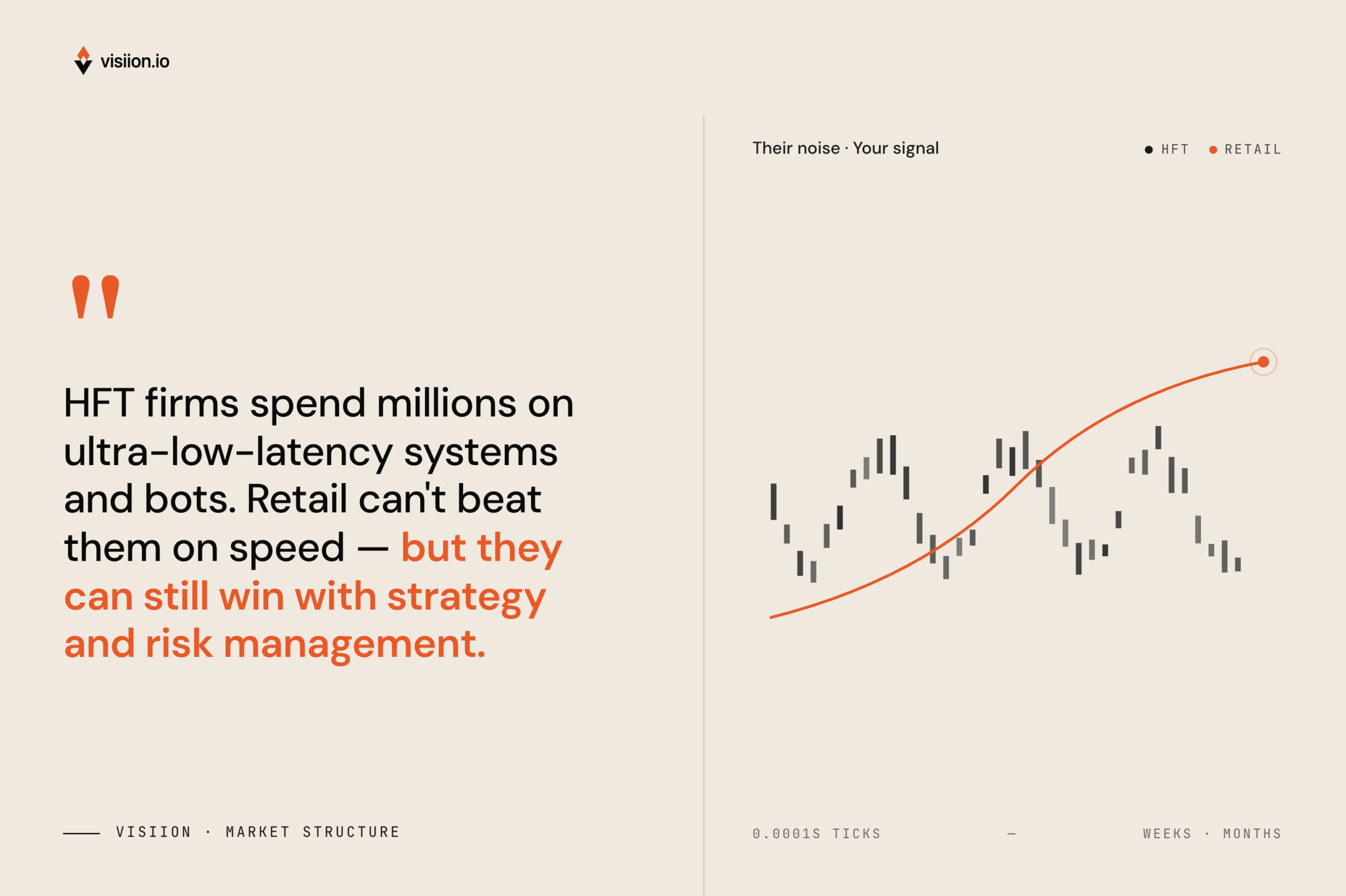
Competing with institutional crypto HFT firms is extremely difficult for retail traders. Big institutional firms invest millions of dollars in the systems that enable bots to execute trades within microseconds.
These firms also have access to deeper liquidity, larger trading capital, extensive human resources, and sophisticated machine learning models that continuously analyze data in real time. Their systems are optimized to detect and react to market opportunities far faster than most retail trading setups. This is what makes it nearly impossible for retail traders to compete directly with HFT firms.
However, retail traders can still succeed in crypto markets. Instead of trying to outperform these firms, retail traders can focus on strategy, risk management, and longer trading timeframes to gain an edge. Practical strategies include swing trading, position trading, and disciplined portfolio management for achieving sustainable success in the market.
Understanding how HFT strategies impact liquidity, volatility, and market behavior can help retail traders make better decisions when navigating high frequency trading dominated markets.
How to Navigate the HFT-Dominated Crypto Market?
Retail traders cannot outperform institutional high frequency trading firms on execution speed, but understanding crypto HFT strategies helps them trade more effectively.
- Use Limit Orders: Market orders can sometimes lead to unexpected prices during high volatility. Limit orders let traders set the exact price at which they buy or sell.
- Avoid Low Liquidity Assets: Cryptocurrencies with low trading volumes are vulnerable to high price volatility, extreme slippage, difficultY exiting positions, and increased risk of rug pulls.
- Monitor Slippage: During periods of high volatility, prices can change rapidly before a trade is executed. Monitoring slippage can help traders avoid costly entries and exits.
- Focus on Risk Management: Proper position sizing, stop-loss strategies, and disciplined trading are often more important than competing with HFT systems on execution speed.
Also Read: What is a Black Swan Event in Crypto?
The Future of High Frequency Trading in Crypto
As crypto markets evolve, high frequency trading will become even more advanced and competitive, with new HFT strategies emerging from AI and machine learning integration.
- AI-Powered Trading Systems: HFT firms now integrate AI-powered systems into their trading infrastructure. This improves tick-by-tick data analysis, automates decision-making, speeds up trade execution, and adapt to the volatile market more efficiently without human intervention.
- Machine Learning and Predictive Algorithms: Advanced machine learning models enable forms to analyse hidden market patterns in crypto HFT, process massive amounts of data in real time, identify manipulation attempts, and detect short-term trading opportunities more quickly than ever before. This predictive capability transforms HFT from reactive arbitrage to proactive market positioning.
- Greater Institutional Adoption: Major institutions are now using dedicated HFT desks to execute trades. This ensures tighter spreads, deeper liquidity, and relentless competition for retail traders attempting HFT strategies.
- Regulation and Transparency Concerns: Regulators worldwide are scrutinizing high-frequency trading in crypto. India’s SEBI, the EU’s MiCA framework, and the US SEC are proposing rules around spoofing, front-running, and market manipulation. Increased compliance costs may make it difficult for smaller HFT firms and retail traders.
Conclusion
High frequency trading and algorithmic market-making systems are major forces in modern cryptocurrency liquidity and price discovery. However, the exact share of HFT-driven trading volume varies across exchanges and institutional venues and is not always publicly transparent. The surface of the crypto market looks like it’s full of human decisions, green candles, red dips, and emotional panic. But under the surface, thousands of trades execute without human touch, driven by code that exists solely to move first.
HFT improves market liquidity, accelerates price discovery, tightens spreads, and makes trading efficient. At the same time, it has introduced new risks such as increased volatility, flash crashes, and concerns about market manipulation.
These systems mostly benefit crypto institutions and firms. However, understanding how HFT works in crypto can help retail traders. Knowledge of HFT strategies, bots, slippage, liquidity, and market behavior can help traders make smarter decisions and navigate market volatility effectively.
With the advancement of artificial intelligence, technology, and an increase in institutional participation, the landscape of high-frequency trading in cryptocurrency will evolve significantly. Platforms that support automated trading, show real-time data, and execute with efficiency will play an important role in the future of crypto HFT trading.
FAQs
Ques: What is high-frequency trading in crypto?
High frequency trading (HFT) in crypto is a type of algorithmic trading that uses automated systems and sophisticated algorithms to execute large volumes of trades within milliseconds. The bots scan multiple exchanges to identify short-term market inefficiencies, arbitrage opportunities, and price movements faster than human traders.
Ques: What is the difference between algorithmic trading and HFT?
Algorithmic trading uses programmed rules to automate trade execution. HFT is a subset that focuses specifically on ultra-fast execution speeds and high trade volumes.
Ques: What is a high-frequency trading crypto bot?
An HFT crypto bot is an automated trading system that can analyze market data, scan exchanges, detect short-lived opportunities, and execute trades without any human intervention. These bots are ultra-fast and react immediately to opportunities in a highly volatile crypto market
Ques: What is the most common HFT strategy in crypto?
Some of the most common HFT strategies in cryptocurrency include arbitrage trading, market making, scalping, momentum-based trading, and order flow analysis.
Ques: Is HFT legal in India?
Algorithmic and high-frequency trading are permitted in India’s regulated securities markets under SEBI frameworks. Cryptocurrency trading, however, is not regulated in the same manner as securities markets. Virtual Digital Asset (VDA) service providers operating in India must comply with FIU-IND and PMLA obligations, while crypto markets remain high-risk and largely unregulated.
Ques. Is High Frequency Trading profitable?
High-frequency trading can be profitable because it allows firms to capture small price differences at very high speed. However, profitability depends heavily on infrastructure quality, execution speed, market conditions, and risk management.
Ques: Will AI replace HFT?
AI is unlikely to replace HFT entirely, but it is expected to significantly improve how HFT systems operate. Many firms are already integrating artificial intelligence and machine learning into trading systems to improve prediction accuracy, automation, and decision-making.