Bitcoin’s 21 Million Hard Cap: Why It Exists, What Happens When It’s Reached, and Will It Ever Change?
Bitcoin has a limited supply. As of May 2026, more than 20 million Bitcoin have already been mined, leaving fewer than 1 million BTC left to enter circulation over the next century. The final Bitcoin is expected to be mined around the year 2140. This fixed supply limit is built directly into Bitcoin’s protocol and is known as the Bitcoin 21 million cap.
This scarcity is the reason why Bitcoin is compared to digital gold. But unlike gold, there is no possibility of mining more if demand rises. No government or central bank enforces the 21 million limit; rather, it is a code.
Bitcoin’s maximum supply of 21 million means that this scarcity shapes the coin’s long-term value proposition. But it also raises major questions, such as why there are only 21 million Bitcoins, why did Satoshi Nakamoto choose 21 million, what happens after 21 million Bitcoin are mined, and whether the hard cap could ever change?
Here’s how Bitcoin’s 21 million supply limit works, why it matters, and what it could mean for investors long term.
What Is Bitcoin’s 21 Million Hard Cap?
The Bitcoin 21 million cap is the fixed supply limit that forms an integral part of its monetary policy. Bitcoin’s maximum supply of 21 million ensures that new BTC cannot be created endlessly.
New Bitcoin enters circulation through mining, where miners validate transactions and earn block rewards. In the early years, miners earned 50 BTC per block. However, these rewards get reduced roughly every four years through events known as halvings.
As block rewards continue shrinking, fewer Bitcoins enter circulation. Eventually, by 2140, all 21 million Bitcoin will have been mined. After that, no new Bitcoins will be entered into circulation. This model reinforces the trust in Bitcoin as a store of value and an inflation-resistant asset.
Also Read: Top Mistakes to Avoid When Purchasing Cryptocurrency Online
Why Is Bitcoin Limited to 21 Million?
The pseudonymous Satoshi Nakamoto designed an asset meant to remain scarce and thereby highly in demand for a long period of time. Bitcoin is limited to 21 million as an alternative to existing inflationary monetary systems.
Traditional fiat currencies can become inflationary due to macroeconomic reasons, reducing purchasing power. This is one of the core ideas behind the broader Bitcoin vs inflation debate, where supporters see Bitcoin as an alternative to inflationary monetary systems. The supply is fixed so that no authority can arbitrarily increase the supply or change the issuance rate.
This predictability serves as a perk for traders and investors alike. Limited supply can increase volatility when demand rises, creating potential trading opportunities. Investors, on the other hand, see Bitcoin as a long-term store of value because of its scarcity.
Why Did Satoshi Set the Bitcoin 21 Million Cap?
The Satoshi Nakamoto Bitcoin supply model has remained a major topic of discussion within the crypto community for years. Satoshi Nakamoto did not give a detailed public explanation for why the limit was set at 21 million. However, in earlier revealed emails, Satoshi suggested that the number was partly an “educated guess”.
Satoshi believed that if Bitcoin became widely used in the future, a limited supply would ensure that each coin would be more valuable over time. And because Bitcoin is divisible into tiny units (satoshis), people wouldn’t need to own a full BTC to use it. Instead of creating billions of Bitcoins, Satoshi chose a smaller supply to enhance the value of individual coins over time.
Furthermore, the Bitcoin 21 million cap is also tied to the coin’s mining and halving system. In 2009, miners earned 50 BTC for each block added to the blockchain. But the rewards were designed to shrink by 50% roughly every four years through halving events.
The table below shows how mining rewards have decreased after every halving event:
| Year | Reward for Miners |
| 2009 | 50 BTC |
| 2012 | 25 BTC |
| 2016 | 12.5 BTC |
| 2020 | 6.25 BTC |
| 2024 | 3.125 BTC |
| 2028 | 1.5625 BTC and so on. |
Technically, Bitcoin’s final supply is slightly below 21 million BTC due to rounding at the satoshi level.
Also Read: Top 5 Strategies Swing Crypto Traders Use
How Many Bitcoins Are Left to Mine?
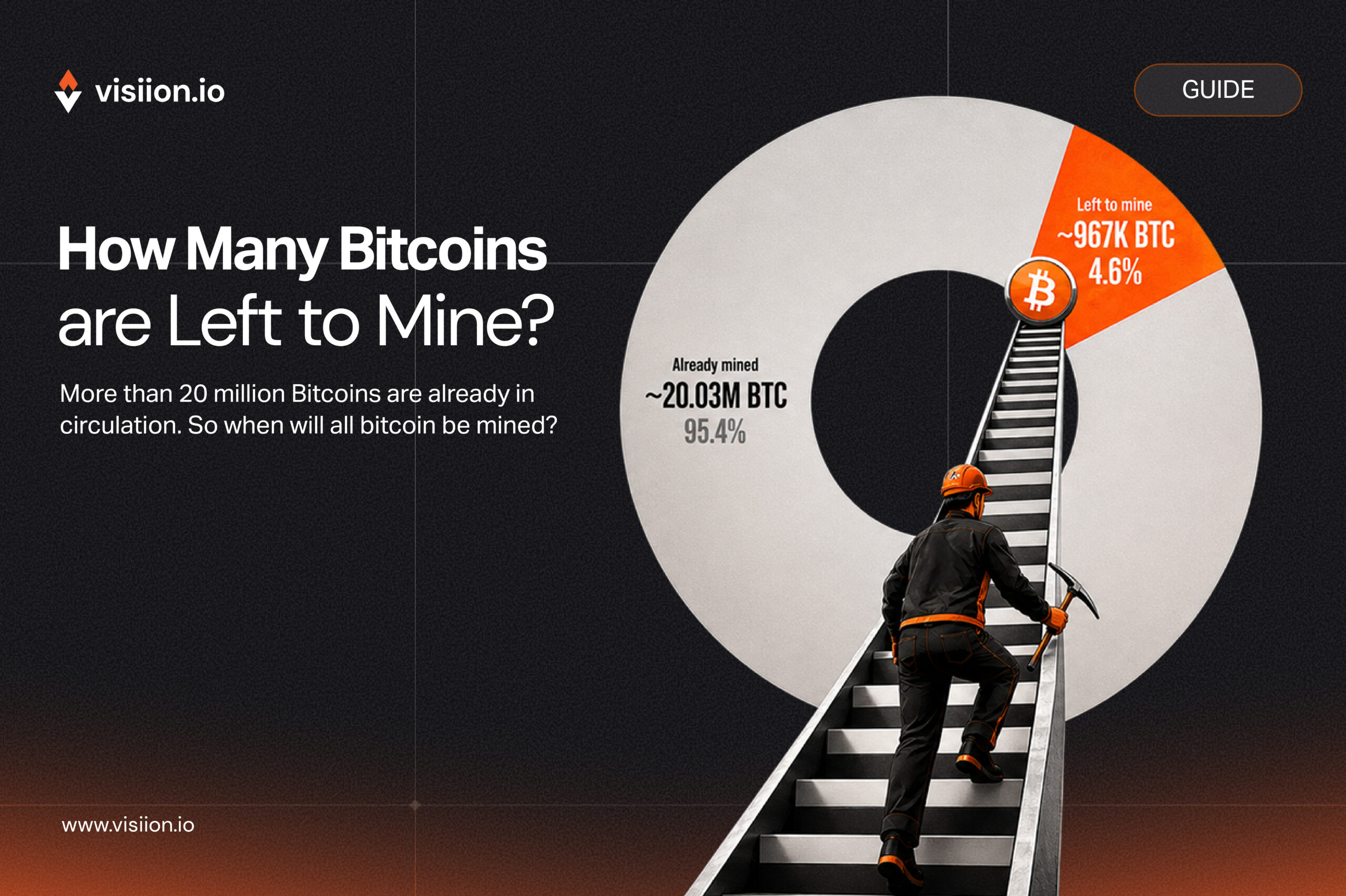
While writing this blog, more than 20 million Bitcoins are already in circulation. This means the supply is already very close to the point where all Bitcoin are mined. This leaves nearly 967,000 coins still left to be mined over the next century.
That said, the remaining coins will take longer to enter circulation because Bitcoin mining rewards have steadily shrunk over the past two decades. As a result, the rate of new Bitcoin creation continues to slow down.
The table below gives a quick breakdown of Bitcoin’s current supply status:
| Bitcoin Supply Metric | Approximate Amount |
| Maximum Bitcoin Supply | 21 million BTC |
| Total Bitcoin Mined | 20+ million BTC |
| Bitcoin Left to Mine | 967K+ BTC |
| Percentage Already Mined | 95.393% |
| Estimated Final Mining Year | Around 2140 |
However, the total amount of Bitcoin actually circulating by 2140 will be less than 21 million. Over the years, millions of Bitcoins are believed to have been permanently lost due to forgotten passwords, lost hardware wallets, or inaccessible private keys.
What Happens When All Bitcoin 21 Million Cap Are Mined?
Once all 21 million Bitcoins are mined, miners will no longer receive new Bitcoins as block rewards. Although Bitcoin mining will not stop entirely. Miners will continue validating transactions and securing the network, and will earn transaction fees paid by users.
However, this future system has sparked an ongoing debate within the community about several issues, like miner incentives, network security, and whether transaction fees alone will be enough to sustain the blockchain long term.
Transaction Fees Post-2140
After the last coin is mined, Bitcoin transaction fees after mining will become the primary source of miner revenue. Some analysts believe growing Bitcoin adoption could generate enough transaction activity to keep miners profitable even without new Bitcoin creation. However, whether transaction fees alone will be enough to sustain the network’s long-term security remains an ongoing debate.
Security Budget Debate
Some analysts believe that shrinking miner rewards will eventually reduce the transaction fees earned. This debate has become increasingly important in discussions around Bitcoin network security after 2140. Critics worry that lower miner incentives could reduce network participation, thereby weakening Bitcoin’s security model. Growing Bitcoin adoption, however, could help offset this concern, as this will result in a higher transaction fee demand.
51% Attack Rise
Following the security budget debate, many experts believe that if mining becomes less profitable in the future, fewer miners will participate in securing the network. Thus, it could increase concerns around a potential 51% attack on Bitcoin in the future. This happens when a single miner or group gains control of most of the network’s computing power.
However, many Bitcoin supporters believe the network’s scale, global mining infrastructure, and economic incentives make such an attack extremely difficult and expensive to carry out.
Also Read: Crypto Regulations 2026: A Complete Guide to the Rules.
Could the Bitcoin 21 Million Cap Ever Change?
Changing the Bitcoin 21 million cap is technically possible, but it would be extremely difficult in practice. Bitcoin is open-source software that allows developers to change its code through network upgrades or forks. But to do that, all the players of the Bitcoin network would have to agree to the change. And without that agreement, the blockchain could split into two separate networks.
Bitcoin has experienced similar splits before through events known as Bitcoin hard forks. In 2017, disagreements within the community over Bitcoin’s scalability led to a blockchain split into two cryptocurrencies, namely, Bitcoin (BTC) and Bitcoin Cash (BCH).
However, many experts want to maintain Bitcoin’s status quo as a scarce asset and limit its supply to 21 million. As a result, increasing the supply could damage trust in the network and weaken the scarcity narrative that supports Bitcoin’s long-term appeal. Furthermore, there is little to no economic incentive for major stakeholders to support such a change.
Conclusion
The Bitcoin 21 million cap remains one of the network’s most defining features. Yes, changing the total supply is possible, but achieving that would require global consensus.
For most, the fixed supply is more than a technical rule. It represents predictability, scarcity, and resistance to inflationary monetary systems. Changing that limit could weaken the trust and long-term value narrative that Bitcoin has built over the years.
As Bitcoin steadily moves towards the hard cap, questions around when all Bitcoin will be mined and how the network will sustain itself afterward will likely continue for decades. However, the 21 million cap remains central to Bitcoin’s identity, and for now, there is little sign that the broader community wants that to change. Even today, Bitcoin scarcity remains one of the network’s strongest narratives.
FAQs
Ques: Why is Bitcoin limited to 21 million?
Satoshi Nakamoto limited Bitcoin to 21 million to make it scarce and resistant to inflation. The fixed supply prevents new coins from being created endlessly like traditional fiat currencies.
Ques: How many Bitcoins are left out of 21 million?
As of 2026, more than 20 million Bitcoin have already been mined. This leaves fewer than 1 million BTC left to enter circulation over the coming decades.
Ques: Why did Satoshi pick 21 million?
Satoshi Nakamoto did not publicly explain why Bitcoin’s supply was limited to 21 million, but simply described it as an “educated guess”. The supply limit being fixed is also tied to Bitcoin’s mining reward and halving system.
Ques: What happens after all the 21 million BTC are mined?
After 21 million Bitcoins are mined, miners will no longer receive a new coin as block rewards. Instead, they will have to rely on transaction fees to continue securing the network.
Ques: Could Bitcoin go to 21 million a coin?
It is difficult to predict whether Bitcoin will ever scale to reach $21 million per coin. Such numbers would require massive global adoption and an extremely large market capitalization.
Ques: How many Bitcoins are mined a day?
Currently, around 450 BTC are mined per day following the 2024 Bitcoin halving. This number decreases after every halving event.
Ques: When will 21 million Bitcoins be mined?
The final Bitcoin is expected to be mined around the year 2140 due to Bitcoin’s gradually slowing issuance schedule.
Ques: What Does Bitcoin’s 21 Million Cap Mean for Traders and Investors?
For traders, Bitcoin’s limited supply can create stronger price movements during periods of high demand. For investors, the hard cap strengthens Bitcoin’s scarcity narrative and long-term store-of-value appeal.