
How to Track Crypto Whale Movements During Holidays?
Tis the holiday season, and you’re living the slow life. The market looks quiet; liquidity is low; traders are still; and nothing seems to be moving. Then a single wallet moves 6000 BTC, and by the time you check your phone the next morning, the market has already turned.
This is why holidays are a dangerous period for crypto traders. The market never sleeps, but most of the players do. And during this period, large transactions are more noticeable than they would be during normal conditions. Whale activity during holidays can suddenly trigger volatility, speculation, or emotional trading.
Traders often worry about how to spot whale activity through whale watching in crypto. But knowing how to track crypto whale movements and interpret them correctly is what separates informed traders from reactive ones.
Why Whale Movements Matter More During Holidays?
Holiday market behavior has been studied across traditional finance for decades. Trading desks often cite lighter volumes, thinner order books, and wider spreads between late December and early January. Crypto markets run nonstop, but they still mirror these dynamics because the number of active traders declines.
During holidays and long weekends, fewer participants are actively trading. This creates an environment where liquidity is low, and the market activity is slow. In this condition, large transactions tend to stand out and create stronger reactions.
For instance, if a whale moves thousands of BTC to an exchange during a holiday weekend, traders may interpret it as a potential sell signal. Even if there is no selling activity, the transfer itself can influence sentiments and trigger short-term volatility.
Also Read: What are Crypto Whales and How They Impact the Market?
The Types of Whale Movements Traders Watch to Track Bitcoin Whales During Holidays
During holidays, traders do not focus on the amount that is being shifted. Rather, they look at where the funds are moving and their context in low-volume market conditions. These are the core movements to understand when you track bitcoin whales in low-liquidity conditions.
Large Transfers to Exchanges
When a whale sends large amounts of crypto to an exchange, it means the funds are now positioned for sale. However, this signals readiness, not intent. The whale may or may not sell off the asset. Holiday conditions make even a moderate deposit trigger selling pressure because of low buyer activity.
Large Withdrawals from Exchanges
This move means that a whale is less interested in immediate selling. Traders may interpret this move as bullish because the assets are being moved away from active trading venues, reducing the amount immediately available for sale.
Stablecoin Transfers
When stablecoins like USDT or USDC are shifted to an exchange, it could mean that a whale is preparing to buy crypto assets. However, most traders overlook this move in favor of BTC and ETH transfers. But significant stablecoin inflows during low-activity periods can be interpreted as whales waiting to enter relatively thin markets.
Dormant Wallets Waking Up
When inactive wallets suddenly become active, they attract attention regardless of market conditions. Holidays only add to the speculation because the overall activity is lower.
Why Whale Alerts Can Be Misleading During Holidays?
One of the biggest crypto lessons for every trader is not to blindly trust what they see. Whale watching in crypto can offer valuable insights about the market. But one has to be careful during the holiday season. A period of low trading activity can blow a whale movement out of proportion and make it look more significant than it actually is.
Not Every Large Transfer is a Sell Signal
Many traders assume that a large transfer signals a major shift in market activity. However, whales can transfer assets for several reasons, including security, staking, or internal management. Whale-tracking services have flagged some of the largest Bitcoin transfers as potential sell signals, only for exchanges to later confirm that they are moving funds between internal wallets.
Thus, traders need to focus on the context rather than the size of the transfer.
Low Liquidity Can Exaggerate Market Reactions
Imagine a whale transfers 2000 BTC to an exchange during a holiday weekend. Traders may interpret this move as a sign of potential selling pressure and try to sell first. This selling creates a downward price pressure, even though the whale in question hasn’t sold anything. Holiday trading periods have relatively fewer participants, which leaves the market extra sensitive to large transactions.
In these situations, traders’ expectations, not the transaction itself, become the main reason why the market moves.
Social Media Tends to Overreact to Whale Alerts
Crypto communities often amplify whale alerts before anyone can confirm the purpose of the transaction. When a dormant wallet suddenly becomes active, traders predict an incoming sell-off. However, many of these movements do not result in major sales. This is why pro traders who know how to track crypto whale movements investigate the reason behind the alert rather than acting immediately.
Also Read: What is the Weekend Effect in the Crypto Market?
How Do Experienced Traders Interpret Whale Activity During Holidays?
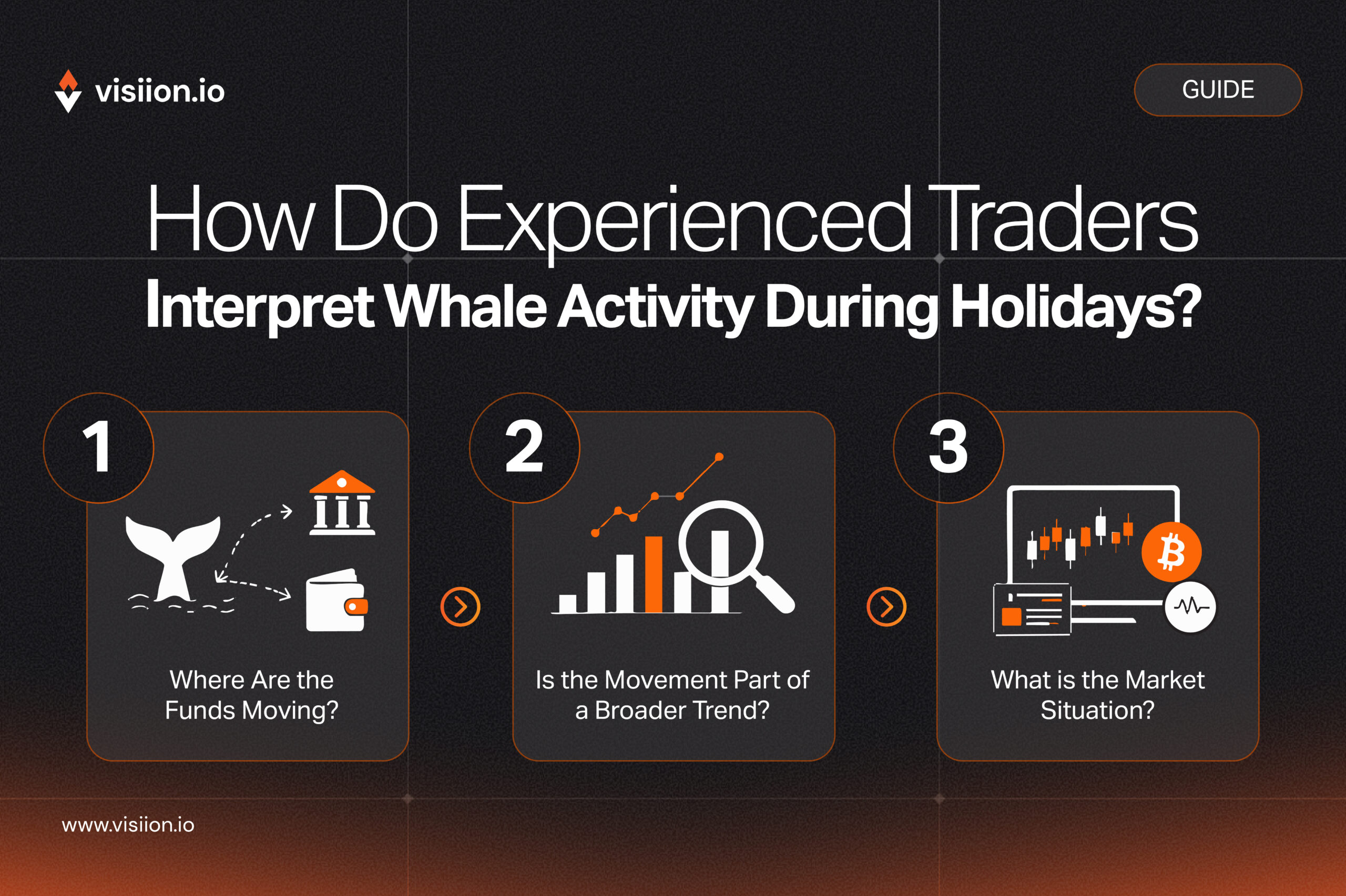
There is no single crypto whale-watching app that gives you the complete picture. Experienced traders use a layered approach and do not treat whale alerts as a signal to act upon. Instead, they treat these signals as starting points for further investigation. Before panicking, they typically ask four questions:
Where Are the Funds Moving?
The destination of the transaction is more important than its volume. Traders examine the broader context of the transaction before making a decision. They use blockchain explorers, which are the most reliable place to track crypto transactions at a granular level and verify the wallet’s history, timing, and whether similar transfers are occurring across other large accounts.
Is the Movement Part of a Broader Trend?
Traders look to see whether whale activity is increasing across the market. Multiple large transfers over several days and increased exchange inflows can reveal trends that a single alert cannot. This is why the ability to monitor whale wallets over time matters more than reacting to individual alerts. By focusing on broader patterns, traders can better understand if the alert is actually meaningful.
What is the Market Situation?
Before deciding whether a transaction is important, pro traders examine various factors, including trading volume, market momentum, macroeconomic developments, and major crypto-related news. If Bitcoin is rising and the market sentiment is positive, the traders may not treat the transfer as a cause for concern. On the other hand, if the prices are falling and the trading volume is low, the same transaction may create additional selling pressure.
Holiday periods can amplify speculation. Rather than reacting immediately to whale alerts, experienced traders wait for additional confirmation before making decisions. Instead, they read the actual market activity and avoid making decisions out of fear or social media narratives.
Also Read: What is a Black Swan Event in Crypto? Meaning, Examples, and How to Prepare?
Conclusion
Learning to track crypto whale movements can help traders identify unusual market activity. But during holiday periods, low liquidity and large transactions can amplify speculation and make whale movements more important than they are.
It is necessary to examine the broader market context to understand if a large transaction is of any consequence. Price trends, trading volume, market sentiment, and major news developments all influence how these movements should be interpreted.
Rather than reacting to every whale alert, experienced traders focus on patterns, context, and confirmation. That is the real discipline behind whale watching in crypto. Not chasing every alert, but knowing which ones actually mean something. During holiday periods, this approach can help separate genuine market signals from noise and reduce the risk of making decisions based on incomplete information.
FAQs
What is whales in crypto?
Crypto whales are individuals, institutions, or entities that hold large amounts of cryptocurrency. Because of the size of their holdings, their transactions can influence market sentiment and, in some cases, short-term price movements.
How Do Traders Track Crypto Whale Activity?
Traders typically monitor blockchain transactions, exchange inflows and outflows, and large wallet movements. They also analyze whether these transactions align with broader market trends before concluding anything.
How do whales manipulate the market?
Large holders can influence market sentiment, particularly during periods of low liquidity. However, a single whale transaction does not automatically move the market. Market conditions, trading volume, and investor reactions all play a role.
Where to Track Crypto Whale Transactions and Monitor Whale Wallets?
Blockchain explorers and on-chain analytics platforms allow traders to monitor wallet activity and large transactions. However, experienced traders focus on interpreting the context behind these movements rather than simply tracking individual wallets.