Stablecoins in 2026: How Digital Dollars Are Reshaping Finance
When you hear anything about crypto, this one word definitely pops into your head: volatility. For years, headlines have been revolving around rising Bitcoin prices, market crashes, and memecoins exploding overnight. Yet one of the industry’s biggest innovations was built to do the exact opposite.
Today, stablecoins are used for cross-border transactions, institutional liquidity management, and on-chain yield generation. This asset is no longer just a crypto-native tool. Governments, banks, and corporations are already integrating stablecoins into mainstream financial systems.
What are stablecoins?
Stablecoins are a type of cryptocurrency that maintains a fixed, predictable value by pegging itself to a fiat currency like the US dollar. In simple terms, stablecoins let you hold dollar value without leaving the blockchain.
Unlike Bitcoin and Ethereum, stablecoins maintain a fixed value, making them com paratively safer for payments, transfers, and storing value on-chain. Major stablecoins include Tether’s USDT, Circle’s USDC, Sky’s DAI, Ethena’s USDe, and PayPal’s USD (PYUSD).
How do stablecoins maintain their peg?
The target value that a stablecoin aims to maintain, usually $1, is known as its peg. For a stablecoin to be reliable for trading, lending, and other financial activities, it must consistently remain at this target value.
Different stablecoins maintain this peg using reserve assets, crypto collateral, or algorithmic supply adjustments. Check the table below to understand how different stablecoins maintain their peg:
| Type of stablecoin | How does it maintain its peg | Examples |
| Fiat-backed | Through arbitrage, which forces traders to buy cheap tokens to redeem for $1.00, or mint new tokens at $1.00 to sell during price spikes. | USDT, USDC |
| Crypto-backed | Through smart contracts, by requiring excess crypto collateral to account for price fluctuations and ensure every token stays fully backed. | DAI |
| Algorithmic | They use a smart contract algorithm to automatically adjust the supply of the stablecoin instead of holding reserve assets. | TerraUSD (UST) (TerraUSD (UST) collapsed in 2022 and is generally cited as a cautionary example rather than a currently viable model.) |
Stablecoins Crossed $300 Billion Market Cap
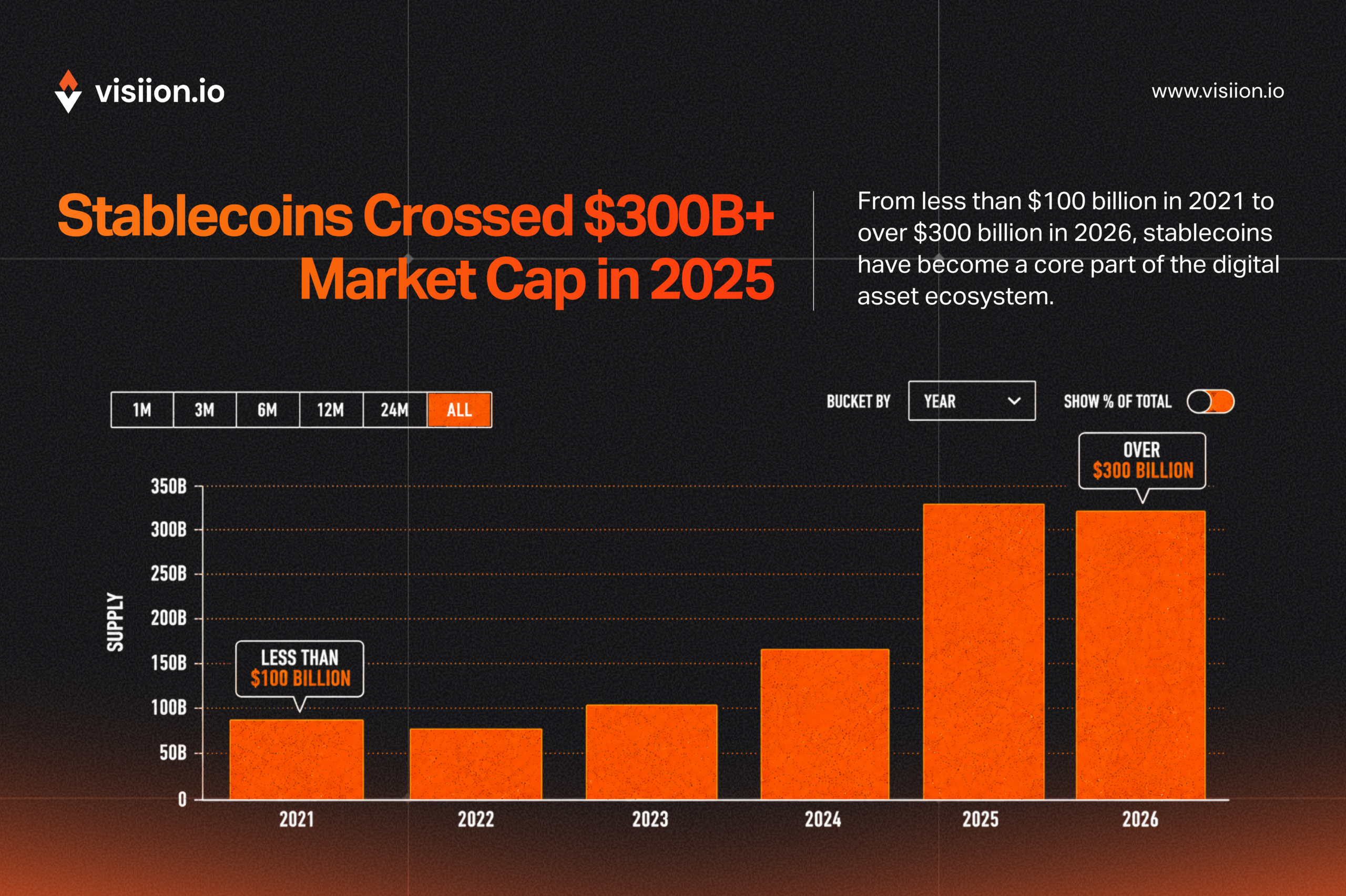
Stablecoins crossed a $300 billion market capitalization in October 2025, marking their evolution from a niche trading tool to core financial infrastructure. As of mid-2026, the market capitalization sits at ~$310 billion. This growth indicates that retail users, institutions, businesses, and payment providers are increasingly adopting these assets. Similarly, the stablecoins’ transaction volume tells us how frequently they are being used. As of July 2026, monthly transaction volume for economically meaningful transfers (excluding exchange-internal and wallet-shuffling activity) stands at $5.5 trillion.
Stablecoins, in other words, have grown past the role of digital dollars sitting in a wallet. They’re becoming payment and settlement infrastructure in their own right.
USDT vs USDC: A Shift in Stablecoin Leadership
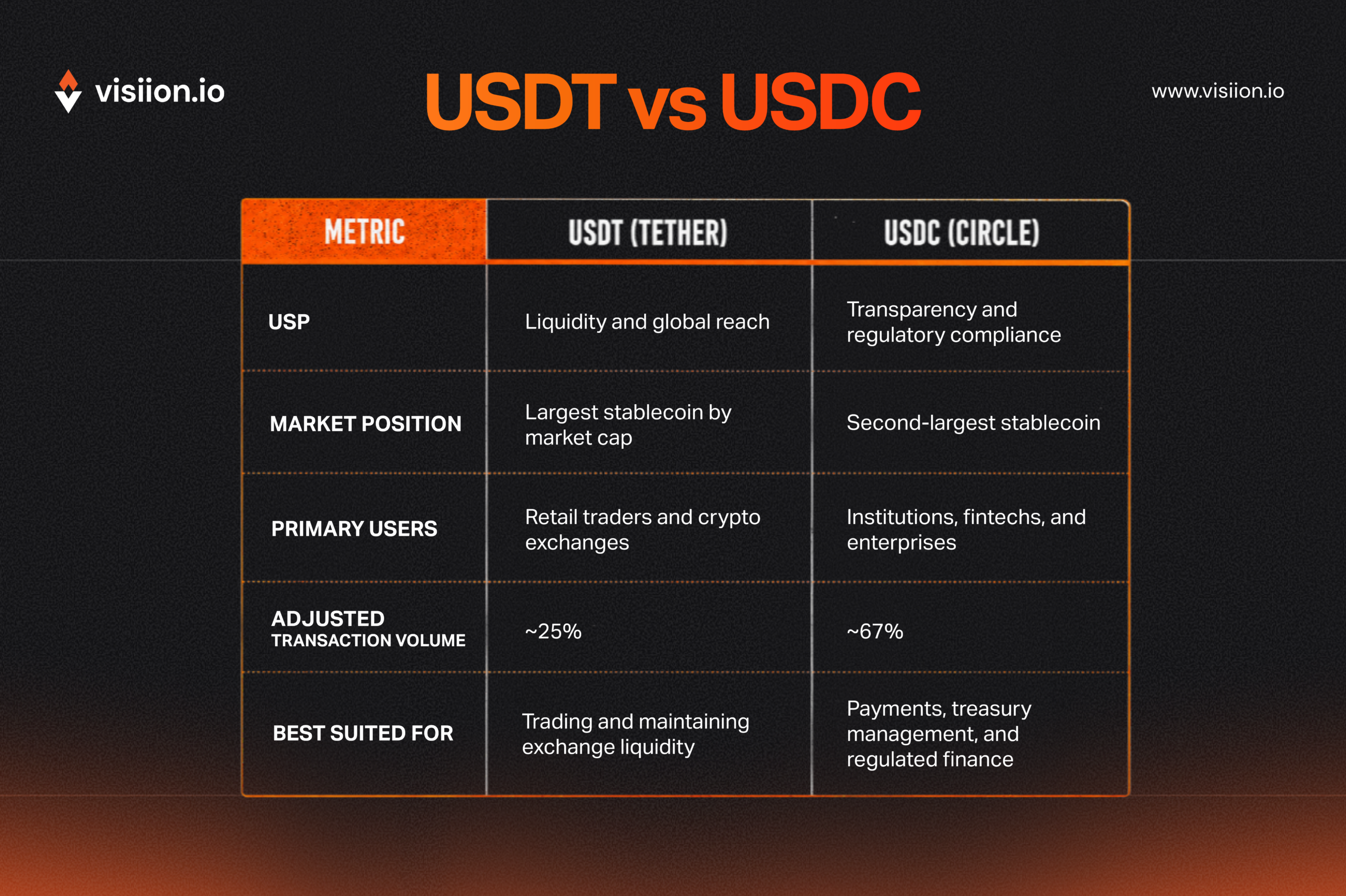
USDT and USDC dominate the stablecoin market, but for different reasons. USDT continues to lead the market because of its scale and liquidity. USDC is popular because it has been gaining traction among institutions and regulated platforms.
USDT has roughly $184 billion in circulation, which constitutes about 60% of the market. USDC holds around $73 billion in market cap, or about 25% of the market. Despite having a smaller market share, USDC has captured roughly 67% of total transaction volume.
Conclusion
Stablecoins have come a long way from being a tool used primarily by crypto traders to avoid market volatility. In 2026, they have become an integral part of the digital financial system, handling cross-border payments and institutional treasury management to on-chain finance.
With further adoption and clearer regulations, stablecoins are expected to evolve into a trusted payment and settlement platform for the global economy.